

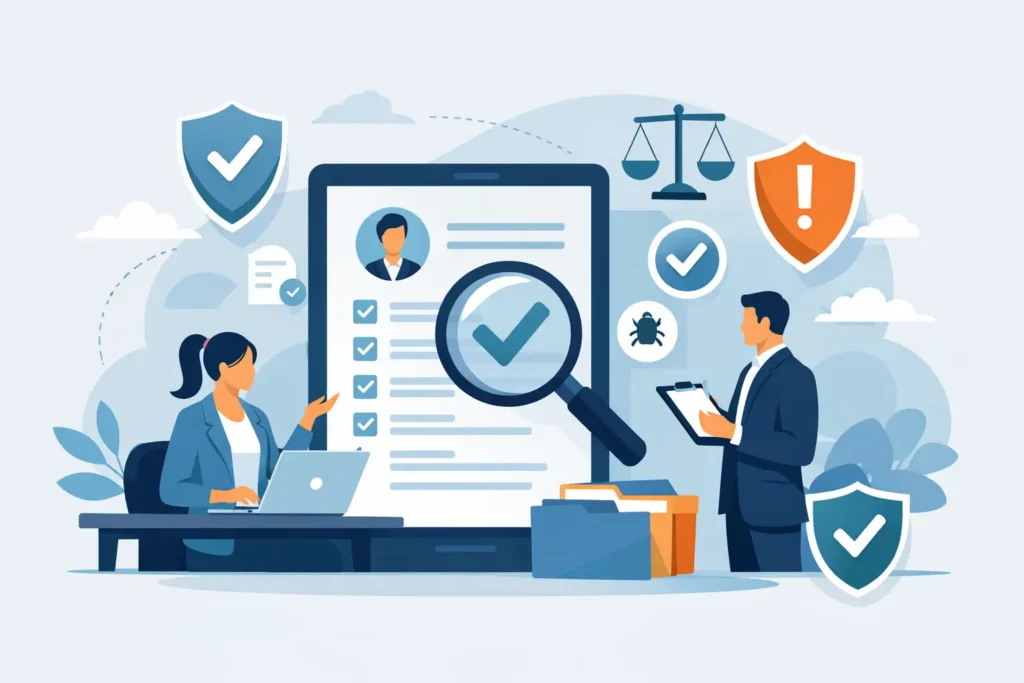
A vendor gets entered once, then shows up everywhere – AP, procurement, onboarding, payment files, and eventually 1099 reporting. If the legal name is off, the TIN is mistyped, or the business record is stale, the error does not stay small. It turns into payment delays, B-Notices, backup withholding issues, and manual cleanup during filing season. That is why knowing how to validate vendors is not a clerical task. It is a control.
For most finance and compliance teams, the real challenge is not whether vendor validation matters. It is how to do it consistently, fast enough for operations, and thoroughly enough to reduce filing risk. A good process needs to catch basic data errors, flag higher-risk records, and create an audit trail without slowing down every onboarding request.
How to validate vendors in a way that holds up
Vendor validation should answer three separate questions. First, does the business actually exist in a form you can verify? Second, does the name and tax ID combination match authoritative records? Third, are there any signs that the record creates fraud, payment, or reporting risk?
Teams often stop after the first question. They find a business name online, confirm there is an address, and move forward. That can be enough for a low-risk purchase in some settings, but it is not enough for 1099 workflows or regulated onboarding. A vendor can be real and still be unfit for your records if the legal name does not match the TIN on file.
The strongest validation process starts before the first payment. If you wait until year-end filing, the work gets harder. You are then correcting records under deadline, chasing vendors for updated tax forms, and exposing your team to preventable penalties.
Start with source documents, not assumptions
The vendor should provide a completed tax form and core business details at onboarding. For most US vendor workflows, that means collecting the correct taxpayer form, legal business name, business classification, TIN, and mailing address. If the information arrives by email, phone, or invoice only, your risk goes up immediately.
A common mistake is relying on the pay-to name or DBA alone. The name used for invoices may not be the legal name tied to the TIN. If your systems store the wrong version, even a valid business can fail matching later. That is where many B-Notices begin – not with fraud, but with bad data discipline.
Verify the business record independently
Once the vendor submits information, validate that the business appears in reliable records. This step helps confirm that the entity is not fabricated, inactive, or materially inconsistent with what was provided. You are looking for alignment across name, address, business identity, and operating status.
This is also where speed matters. Manual searching across scattered sources can work for a few vendors a month. It breaks down quickly for firms handling contractor onboarding, seasonal payment surges, or large AP files. At volume, validation has to be repeatable and documented.
Match the TIN and legal name before you pay
If your process includes 1099 reporting, TIN matching is the control that separates basic onboarding from compliance-grade validation. A vendor record is not truly validated until the legal name and TIN are checked together.
This is the step many teams postpone because it feels operationally inconvenient. But the trade-off is simple. You either validate early while the vendor is engaged, or you fix mismatches later when money has already gone out and filing deadlines are close. Early validation is cheaper.
Direct TIN matching is especially important when a vendor has multiple entities, recently changed names, or uses a common trade name. In those cases, a quick visual review may give false confidence. A record can look plausible and still fail IRS matching.
For firms with ongoing vendor volume, using a system that combines business record search with direct TIN matching reduces rework. Instead of checking identity in one place and tax validation in another, teams can move from lookup to match in the same workflow. EINSearch.io is built for that exact problem – helping teams verify vendor and contractor records before filing errors become operational issues.
Watch for mismatch patterns that signal risk
Not every mismatch means fraud, but every mismatch needs a reason. A transposed digit, a shortened legal suffix, and a recent entity conversion create different levels of concern. The right response depends on the pattern.
If the name is close but not exact, review whether your record uses a trade name instead of the legal taxpayer name. If the TIN format is invalid or the entity cannot be found in credible records, stop and escalate. If the vendor resists correcting basic taxpayer information, treat that as a control issue, not a customer service inconvenience.
This is also where fraud screening overlaps with tax validation. A vendor created in a rush, with limited business footprint and inconsistent identifiers, deserves more scrutiny than an established business with a simple clerical mismatch.
Build a vendor validation workflow your team can repeat
The best process is not the most complex one. It is the one your AP, tax, procurement, and onboarding teams can actually follow every time. In practice, that means standardizing validation checkpoints and assigning ownership.
At a minimum, the workflow should require collection of taxpayer information, independent business lookup, TIN and name matching where applicable, and exception handling for failed or partial matches. It should also define when a vendor can be paid, when a record must be corrected, and when backup withholding rules may need review.
For small teams, this may be a controlled manual process with documented review steps. For larger organizations, batch validation and API-based checks become more practical. The trade-off is straightforward. Manual review offers flexibility, but it does not scale well and usually leaves weaker audit documentation. Automated validation improves speed and consistency, but only if the underlying rules are set correctly.
Treat vendor master data as a compliance asset
Many filing problems begin long before tax season because the vendor master file is treated as an administrative database instead of a controlled compliance record. Once bad data enters the system, it spreads into payment operations, procurement systems, and reporting outputs.
That is why validation should not be one-time only. Vendor records need refresh points. If a vendor changes ownership, updates its legal name, submits a new tax form, or returns a failed match, the record should be revalidated. High-volume teams should also run periodic reviews on existing vendors, especially before 1099 filing cycles.
A stale but previously valid record can still create filing risk. The process should account for that reality rather than assuming every approved vendor remains accurate forever.
Common failure points when validating vendors
Most vendor validation failures are operational, not technical. Teams skip steps because onboarding is rushed. They accept incomplete forms to avoid delaying payment. They rely on invoice data instead of taxpayer data. Then the mismatch shows up months later when the correction is harder.
Another frequent issue is fragmented ownership. Procurement may collect the vendor. AP may set it up. Tax may only see the record at year-end. If no one owns the full validation chain, gaps are predictable. The fix is not more policy language. It is a tighter workflow with defined controls and system checkpoints.
There is also a scale problem. What works for ten vendors does not work for ten thousand. If your team validates one by one using inconsistent search methods, accuracy drops as volume rises. That is where centralized data, batch matching, and real-time verification tools start paying for themselves.
What good vendor validation looks like
A validated vendor record should be usable, traceable, and defensible. Usable means the business can be paid without creating downstream confusion. Traceable means your team can show what was collected, what was verified, and when it happened. Defensible means that if a filing issue arises, you can show a reasonable, documented process designed to prevent it.
That standard matters for more than compliance. It improves payment accuracy, reduces onboarding delays, and lowers the number of year-end corrections your staff has to chase. It also protects trust with vendors by resolving issues early, when they are easier to fix.
If you are deciding how to validate vendors, the right answer is usually not more manual review. It is a process that checks business identity, confirms TIN and legal name accuracy, routes exceptions quickly, and keeps validation close to onboarding instead of year-end filing.
The cleanest vendor record is the one you verified before the first payment ever went out.