

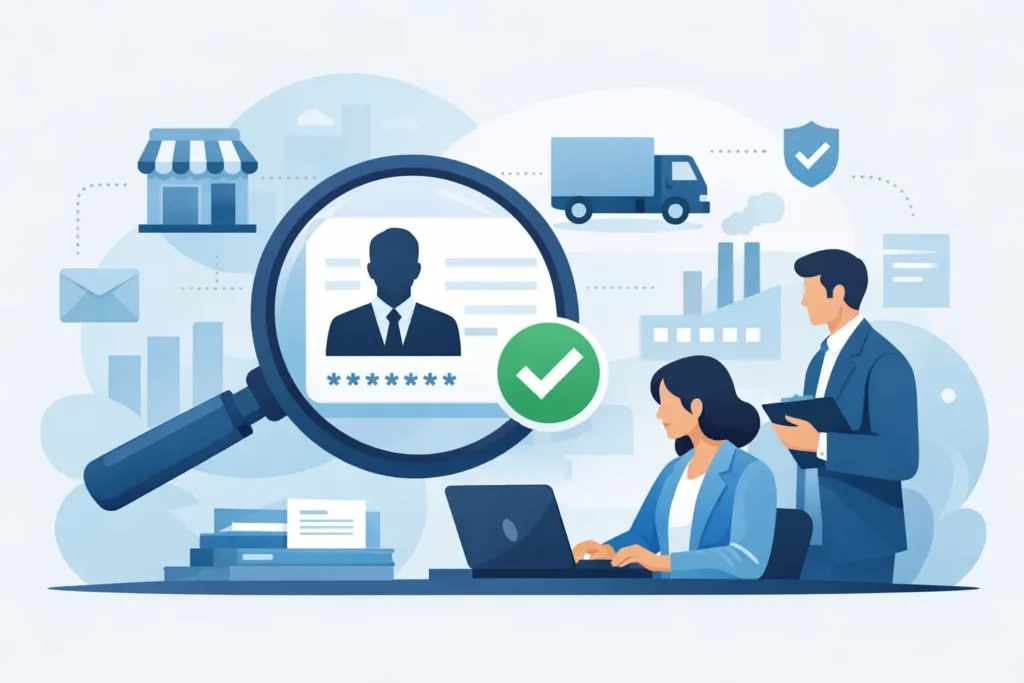
A vendor record can look complete and still create a filing problem. One transposed digit, an outdated legal name, or an EIN tied to a different entity can trigger a B-Notice, delay payment, and leave your team correcting records under a deadline. An EIN search gives accounts payable, tax, and onboarding teams a fast way to investigate business identity before bad data reaches a 1099 file.
The key distinction is simple: finding an EIN is not the same as confirming that an EIN and taxpayer name match IRS records. Both activities matter. They solve different points of failure in a vendor compliance workflow.
What an EIN Search Can Tell You
An Employer Identification Number is the federal tax ID generally used by businesses, estates, trusts, and other entities for tax reporting. In a vendor workflow, an EIN search can help your team locate or assess business information associated with an organization, including its likely legal name, address history, industry details, entity status, and related identifiers where available.
This is especially useful when the information supplied on a W-9 is incomplete or does not align with the vendor record in your ERP. A search may reveal that the vendor uses a trade name while its tax reporting name is different, or that the address in your system belongs to an older location. That context helps your team ask the right follow-up question before processing payments or preparing year-end reporting.
Search results are valuable for research and record cleanup, but they should not be treated as IRS confirmation. Public and commercial business data can be incomplete, delayed, or associated with a similarly named company. An entity can also change addresses, operating names, or ownership details without every data source updating at the same time.
For a filing decision, the higher standard is TIN matching: validating that the taxpayer identification number and legal name provided by the payee align with IRS records. That distinction prevents a common compliance mistake: assuming a plausible lookup result means a vendor is verified for 1099 reporting.
EIN Search vs. IRS TIN Matching
An EIN search answers a research question: “Who is this business, and does the information we have appear credible?” IRS TIN matching answers a filing-risk question: “Does this taxpayer name and TIN combination match the IRS database?”
Use search early in onboarding, during vendor remediation, and whenever a record lacks clear identifying details. It can help resolve duplicate supplier profiles, identify likely name variations, and flag records that need a new W-9. It is also useful when a payment team needs to confirm it is dealing with the intended business rather than a similarly named entity.
Use IRS TIN matching before submitting information returns and after receiving a corrected W-9. The IRS match process is designed for authorized payers and reporting agents that need to validate payee information for information reporting purposes. It is the control that directly addresses the name-and-TIN mismatch behind many B-Notices.
The strongest workflow uses both. Search establishes context. TIN matching establishes tax-reporting confidence. Treating either one as a replacement for the other creates an avoidable gap.
When Vendor Records Need Immediate Review
Some records deserve more than routine processing. A vendor that changes its banking information and tax identity at the same time, for example, presents a different risk profile than a stable vendor submitting an annual address update. The right response depends on the payment amount, relationship history, internal controls, and the reason for the change.
Prioritize an EIN search and validation review when a contractor submits a new W-9 after payments have already started, when the legal name differs from the invoice name, or when an existing vendor profile contains a missing or obviously malformed TIN. Review is also warranted when multiple vendor records share similar names, addresses, phone numbers, or bank accounts.
Fraud prevention is part of the equation. Business impersonation schemes often rely on small changes that appear routine: a revised remittance address, a new contact email, or a slightly altered entity name. Tax ID validation cannot validate bank ownership by itself, but it can expose identity inconsistencies before a payment change is approved.
Build EIN Search Into Your Vendor Workflow
A reliable process does not wait until January to discover vendor data problems. The further a mismatch travels through procurement, accounts payable, and tax reporting, the more expensive it becomes to fix. Build checks into the points where data enters or changes.
At onboarding
Collect a completed W-9 before the first reportable payment whenever possible. Confirm that required fields are present, preserve the form according to your document-retention policy, and compare the taxpayer name and TIN to the vendor profile. If the business identity is unclear, perform an EIN search to investigate the record and request clarification rather than guessing.
Before payment changes
Treat tax identity changes as controlled events. A new DBA may be legitimate, but a legal-name or TIN change can indicate a new entity that requires a new vendor record. Route exceptions through the appropriate approval path and document why the change was accepted.
Before 1099 filing
Run a broad review of reportable payees before filing season closes. This is where batch processing has a clear advantage: teams can identify missing values, invalid formats, duplicate records, and name-TIN mismatches across a large vendor file rather than reviewing records one at a time. Resolve exceptions while the payee can still provide a corrected W-9.
For firms managing high volume, an API-based workflow can apply these controls as vendor data enters the system. The best implementation depends on transaction volume and system maturity. A small accounting practice may need fast one-off lookups and a clean batch review before filing. An enterprise onboarding team may require role-based access, audit records, automated exception queues, and integration with procurement or ERP software.
Common Mistakes That Create Filing Risk
The first mistake is relying on invoice information as tax documentation. An invoice may show a recognizable business name but omit the legal taxpayer name, use a DBA, or contain outdated details. A W-9 and appropriate validation process remain the foundation for reportable payees.
The second is normalizing vendor names without preserving the submitted tax name. Removing punctuation or standardizing abbreviations may improve search and duplicate detection, but it can obscure the exact name needed for reporting. Keep the source value, record any normalized display value separately, and investigate meaningful differences.
The third is treating a no-result search as proof that an EIN is invalid. Not every organization will appear in every business-data index, and certain entity types have limited public information. A no-result should trigger review, not an unsupported conclusion. Request documentation, verify the source, and use authorized IRS matching when the record is intended for information reporting.
The fourth is postponing corrections until forms are being produced. By that point, staff are working against filing deadlines, vendors may be slow to respond, and the cost of manual rework rises quickly. Data quality is an operating control, not a January project.
Choose Tools That Support Audit-Ready Decisions
A useful EIN search platform should do more than return a possible business name. It should support the way compliance teams actually work: quick searches for isolated records, structured data for review, batch capability for vendor files, and clear separation between business research and IRS validation.
Look for controls that fit your risk level. High-volume teams may need user permissions, shared case visibility, export controls, documented results, and API access. Firms that file for multiple clients may need consistent workflows that reduce reliance on individual staff knowledge. In either setting, speed matters only when the result is usable and traceable.
EINSearch.io combines business identity search, IRS TIN matching, batch workflows, and API access in one compliance-focused environment, helping teams move from uncertain vendor records to documented validation decisions without piecing together disconnected tools.
An EIN search is most valuable when it leads to action: correct the vendor profile, request a new W-9, validate the taxpayer name and TIN, or escalate a suspicious change. Put that decision path in place before the next vendor record arrives, and filing season becomes far less likely to expose problems your team could have prevented.