

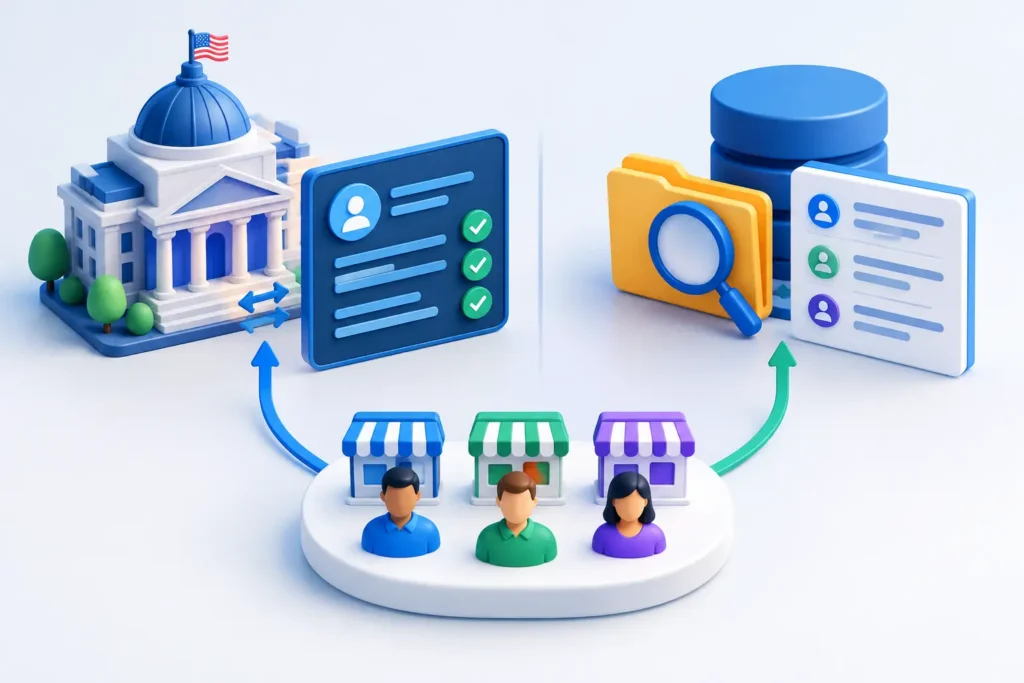
A vendor submits a W-9, the payment team creates the record, and the business name and tax ID appear to match. That is not yet proof that the record will pass an IRS filing check. IRS matching versus data lookup is a practical distinction that determines whether your team is collecting useful business intelligence, validating a taxpayer record for reporting, or doing both before money moves.
For accounts payable, tax compliance, onboarding, and fraud teams, the difference is not academic. A lookup can help identify a business in seconds. IRS TIN matching can help prevent a name-and-TIN mismatch that leads to B-Notices, corrected filings, backup withholding work, and vendor outreach at the worst possible time.
What Data Lookup Actually Does
A data lookup searches a business information index using details such as an EIN, legal name, DBA, address, phone number, industry, or corporate registration information. Its purpose is discovery and enrichment. The result may help a team determine whether a vendor appears established, whether the supplied EIN is associated with a known business, or whether a submitted name conflicts with available records.
This matters during vendor onboarding because W-9 information is self-reported. A lookup can surface obvious problems before the record reaches the payment system: a transposed digit, a business name that does not align with the EIN, an address that belongs to a different entity, or a vendor that has little supporting business presence.
Data lookup is also built for speed and availability. It can return information when an operations team needs an immediate decision, such as approving a merchant account, setting up a new payee, reviewing a credit application, or clearing a contractor record before a payment run. For high-volume organizations, it is often the first line of defense because it reduces the number of incomplete or suspicious records sent to later review.
But lookup data is not automatically an IRS confirmation. Data sources can be broad, current, and highly useful while still reflecting public records, proprietary records, submitted information, and historical business data rather than a direct match against IRS taxpayer-file information. Treating an EIN search result as a filing-level validation can create a false sense of security.
What IRS TIN Matching Confirms
IRS TIN matching compares the taxpayer identification number and name combination against IRS records. For business reporting workflows, the goal is simple: determine whether the payee name and TIN provided on a W-9 match the information the IRS expects for information returns.
This is the control that directly addresses a common 1099 risk. A vendor may be a real company with a real EIN, yet the legal name entered in your ERP may be abbreviated, outdated, misspelled, or tied to a prior entity structure. A general data lookup may recognize the company. IRS matching is designed to test whether the exact submitted taxpayer name and TIN combination is valid for reporting.
The distinction becomes critical before filing Forms 1099-NEC, 1099-MISC, and other information returns. When the payer submits an incorrect combination, the IRS may issue a B-Notice. That can force your team into documentation requests, payee communications, backup withholding decisions, correction cycles, and audit-trail reconstruction.
IRS matching is not a substitute for all vendor due diligence, either. A successful TIN match does not tell you whether a supplier is financially stable, authorized by your procurement team, subject to sanctions screening, or safe from an operational fraud perspective. It validates a tax identity pairing. Those are different controls, and mature onboarding programs need each of them.
IRS Matching Versus Data Lookup: The Operational Difference
The right question is not which method is better in every case. It is which question your team needs answered at that point in the workflow.
Use data lookup when you need fast identity context. It is useful for locating an EIN, checking whether a business record exists, comparing vendor-submitted details against available data, enriching a sparse record, and flagging inconsistencies before setup. It is especially valuable when a user has partial information or needs a subsecond response during an approval flow.
Use IRS TIN matching when you need filing-focused name-and-TIN validation. It belongs before 1099 filing, during W-9 intake, after vendor master changes, and whenever a payee record creates a compliance concern. If the objective is to stop B-Notices and reduce reporting errors, IRS matching is the necessary control.
The strongest workflow uses both in sequence. Start with lookup to resolve and enrich the entity. Then apply TIN matching to validate the reportable tax identity. If either step returns a conflict, hold the record for correction before payment or filing rather than allowing an unresolved mismatch to become a year-end emergency.
Why Speed Changes the Decision
Traditional verification processes often create a false choice between fast onboarding and careful compliance. A team either approves a vendor immediately with minimal review or delays the request until someone can manually research the record. Neither approach scales well.
Fast data lookup changes the front end of the process. It gives onboarding teams usable context while the vendor, customer, or contractor is still engaged. That matters for merchant account approvals, financial services applications, telecom accounts, and supplier setup, where delays can cause qualified applicants to abandon the process.
Fast TIN matching changes the back end of the process by making compliance validation practical at the point of entry rather than after a batch is prepared for filing. An always-on verification environment is particularly useful when IRS systems are unavailable or when an organization cannot wait for a manual queue to clear. The operational benefit is not merely speed for its own sake. It is the ability to prevent bad records from entering downstream systems.
EINSearch.io combines a 25 million EIN database with a 700 million tax ID data index and direct IRS TIN matching capabilities, allowing teams to use rapid lookup for identity context and matching for compliance-focused validation. For enterprise users, that approach can support API calls, batch files, and repeatable controls across multiple business units.
Common Mistakes That Create Filing Risk
The most expensive errors are usually small. A user enters a DBA when the IRS record requires the legal taxpayer name. An accounts payable clerk copies an EIN from an invoice without collecting a current W-9. A vendor master record keeps an old legal name after a merger or entity conversion. The team runs a business lookup, sees a plausible result, and assumes the tax identity is verified.
Another frequent mistake is waiting until January to perform validation. By then, unresolved records are mixed into payment history, vendor contacts may be unresponsive, and filing deadlines are close. Bulk IRS TIN matching for 1099 preparation is valuable, but it should be a safety net, not the first time a vendor record is reviewed.
Finally, do not ignore non-matches as a technical exception. A mismatch is an operational signal. It may be a simple formatting issue, but it can also indicate outdated vendor information, identity misuse, invoice fraud, or an attempt to route payments to an unauthorized entity. The correct response depends on the facts, but the record should not move forward unchanged.
Build Verification Into Vendor Onboarding
Effective controls begin with a current W-9 and a clear rule that vendor setup is not complete until required identity fields are reviewed. The legal name, entity classification, address, and TIN should be captured consistently. A lookup can then help resolve incomplete information and flag contradictions before staff create the vendor record.
Next, run TIN matching at the point where the business needs reporting confidence. For some organizations, that is immediately at onboarding. For others, it may be before the first payment, after a material vendor master update, or as part of a scheduled compliance review. The best timing depends on transaction volume, risk tolerance, system integration, and the cost of holding a record for correction.
For large vendor populations, automate the process through an API or batch workflow. Establish exception routing so a non-match reaches the right person, and retain the result with the vendor record. An audit-ready process should show what information was submitted, when it was checked, what result was returned, and how the exception was resolved.
A good verification program does not force your team to choose between fast decisions and defensible compliance. Use data lookup to understand who is in front of you. Use IRS TIN matching to confirm whether the tax identity is ready for reporting. That one distinction can keep a routine vendor setup from becoming a B-Notice, a payment error, or a preventable year-end fire drill.