

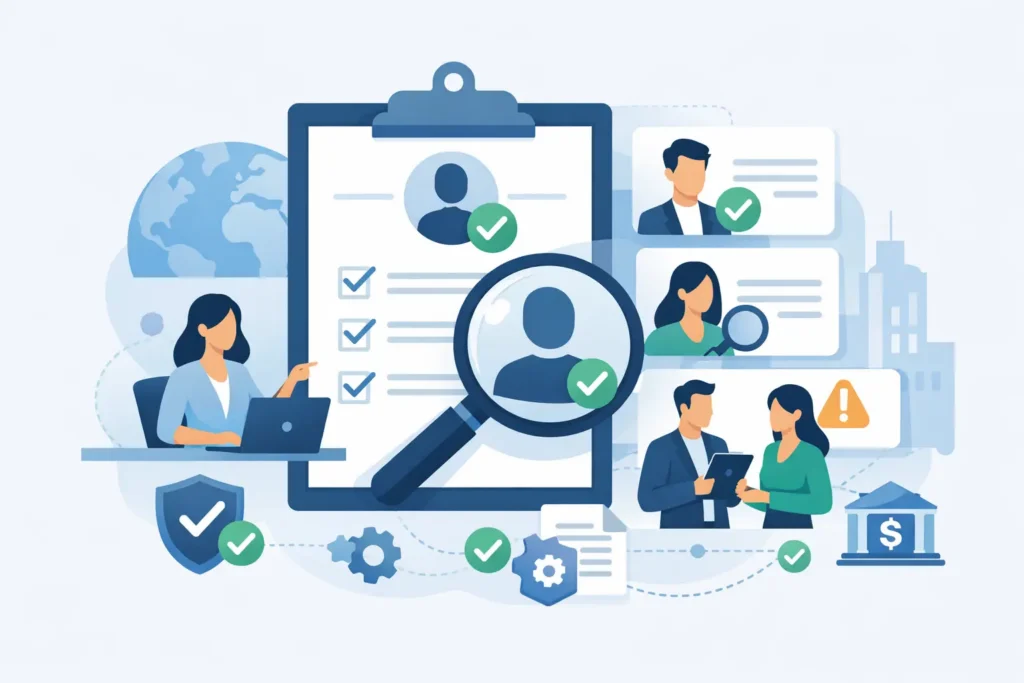
A bad vendor record usually stays invisible until it costs you money. The payment goes out to the wrong business name, a 1099 fails TIN matching, or your team spends days cleaning up records after a B-Notice arrives. That is why buyers looking for the best vendor verification platforms are not really shopping for software alone. They are trying to reduce filing risk, prevent fraud, and keep onboarding moving without adding manual review.
The hard part is that vendor verification means different things depending on your workflow. For AP teams, it may mean confirming legal business identity before payment. For tax operations, it means validating EIN and TIN data before 1099 filing. For financial institutions and enterprise onboarding teams, it often includes watchlist screening, document collection, fraud checks, and audit trails. The right platform depends less on broad feature claims and more on whether it fits the control points in your process.
What the best vendor verification platforms actually do
The strongest platforms do more than basic business lookup. They help confirm that a vendor is real, active, and properly matched to the data you need for payment and reporting. That can include legal name verification, EIN or TIN matching, address validation, beneficial ownership review, sanctions screening, document capture, and batch processing for large files.
For tax and reporting teams, one capability matters more than most – accurate identity matching before filing. If a platform cannot help you validate vendor tax records at the point of onboarding or before year-end reporting, it may still support procurement, but it will not solve the compliance problem that creates rework and penalties.
How to evaluate the best vendor verification platforms
Start with your actual failure points. If your main issue is 1099 corrections, B-Notices, and mismatched tax IDs, prioritize IRS-aligned TIN matching, EIN lookup, and batch verification. If your problem is broader third-party risk, you may need more document-heavy onboarding and monitoring tools.
Speed also matters. A platform that requires long manual review for every vendor may improve control on paper while slowing operations in practice. The better approach is targeted verification – instant checks for standard cases, stronger exception handling for high-risk records, and clear audit logs for what was verified and when.
Integration is another dividing line. Many teams can tolerate a browser workflow for occasional checks. High-volume organizations usually cannot. If your staff is uploading vendor files, onboarding thousands of contractors, or validating records across multiple business units, API access and batch processing move from nice-to-have to required.
1. EINSearch.io
For organizations focused on business tax ID accuracy, EINSearch.io stands out because it is built around verification rather than generic business search. The platform combines a large business data index with direct IRS TIN matching, which is especially useful for firms trying to stop 1099 filing errors before they happen.
Its practical advantage is consolidation. Instead of sending teams to one tool for EIN lookup, another for tax ID matching, and another process for batch cleanup, it brings those steps into one compliance-focused workflow. That is a strong fit for accounting firms, payroll providers, tax professionals, and enterprise AP or onboarding teams that need fast validation without stitching together multiple systems.
The trade-off is scope. If you need deep supplier lifecycle management, procurement orchestration, or broad global entity due diligence, you may still pair it with another platform. But for US-based EIN, TIN, and vendor tax verification, it is purpose-built for the problem that causes filing risk.
2. LexisNexis Risk Solutions
LexisNexis is often used when vendor verification sits inside a wider risk and identity framework. Large institutions choose it for data depth, screening capabilities, and enterprise controls. It can support more complex due diligence environments where vendor review overlaps with fraud prevention, business identity intelligence, and ongoing monitoring.
That breadth is valuable, but it can also be more than some finance teams need. If your immediate goal is fast tax ID validation for vendors and contractors, a broader risk platform may introduce cost and complexity beyond the use case. It is strongest where vendor verification is one piece of a larger compliance architecture.
3. Dun & Bradstreet
Dun & Bradstreet remains a familiar option for commercial entity validation and supplier intelligence. Teams often use it to confirm company existence, review business profile data, and support vendor master data quality. For procurement and supplier management teams, that can be useful during onboarding and ongoing vendor review.
Its strength is commercial business information at scale. Its limitation for tax operations is that business identity data alone does not always equal tax reporting readiness. You may still need separate tax ID matching workflows if the core problem is name and TIN accuracy for 1099 reporting.
4. Middesk
Middesk is frequently considered by fintechs and modern onboarding teams that need business verification with a clean product experience and API-first delivery. It is well suited for organizations that want to verify businesses during account opening, merchant onboarding, or embedded finance workflows.
The platform is attractive when engineering teams want fast integration and automated decisioning. The question is whether its feature set maps directly to your tax compliance process. If your pain is operational onboarding for digital business customers, it may fit well. If your pain is year-end tax filing accuracy, the fit depends on how much direct TIN validation support you need.
5. Thomson Reuters CLEAR
CLEAR is often used in investigative, compliance, and due diligence environments where users need access to broad public records and connected business information. It can support deeper research into entities, ownership, and potential risk signals.
That makes it useful for exception handling and higher-risk reviews. It is less ideal as a lightweight, day-to-day validation tool for every vendor record unless your team is staffed for investigative workflows. For many AP and tax teams, it works better as a specialized review layer than as the primary verification engine.
6. Socure
Socure is best known for digital identity and fraud decisioning, but some organizations evaluate it when business verification and fraud controls intersect. In environments where you are validating both the entity and the user behind the transaction, that can be helpful.
Still, Socure is not usually the first platform finance teams choose for pure vendor tax verification. Its value tends to increase when the business problem includes fraud analytics and digital onboarding risk, not just vendor master accuracy or 1099 compliance.
7. Persona
Persona is another platform that enters the conversation when verification is part of a configurable onboarding flow. It offers flexibility, workflow logic, and identity orchestration that can be useful for platforms managing mixed verification requirements.
That flexibility comes with a common trade-off – more configuration, more process design, and a need to define exactly what verification signals matter for your operation. For teams that want a direct, compliance-focused answer to vendor EIN and TIN validation, a more specialized platform may get to value faster.
Which best vendor verification platforms fit each use case?
There is no single winner for every team. If you are a tax professional, accounting firm, payroll provider, or AP department trying to reduce B-Notices and filing errors, specialized EIN and TIN validation should lead your selection criteria. In that case, a platform centered on tax ID verification will usually outperform a general business intelligence tool.
If you run enterprise onboarding across multiple risk layers, broader verification platforms may make more sense. They can support document workflows, screening, and higher-order due diligence that go beyond tax reporting. Just be careful not to confuse broad coverage with precise fit. Many teams overbuy complexity and still need a separate process for the tax matching step that actually creates penalties.
What to ask before you buy
Ask vendors how they handle exact name and tax ID matching, not just entity search. Ask whether they support batch verification for large vendor files and whether audit records are easy to export for internal controls. Ask how quickly a user can move from a raw vendor record to a verified result that is ready for payment or filing.
You should also ask what happens when data does not match. Exception handling is where operational cost shows up. A platform that gives clear mismatch signals, reason codes, and practical remediation paths will save more time than one that only returns a vague failure.
Finally, check who the product was built for. A platform designed for procurement visibility may not solve tax compliance. A platform designed for consumer identity may not resolve business vendor records cleanly. The best software is usually the one closest to the operational risk you are trying to remove.
Vendor verification should not start at year-end when filing deadlines are close and cleanup is expensive. The right platform gives you a cleaner vendor file every day, so fewer problems survive long enough to become penalties, delayed payments, or avoidable fire drills.