

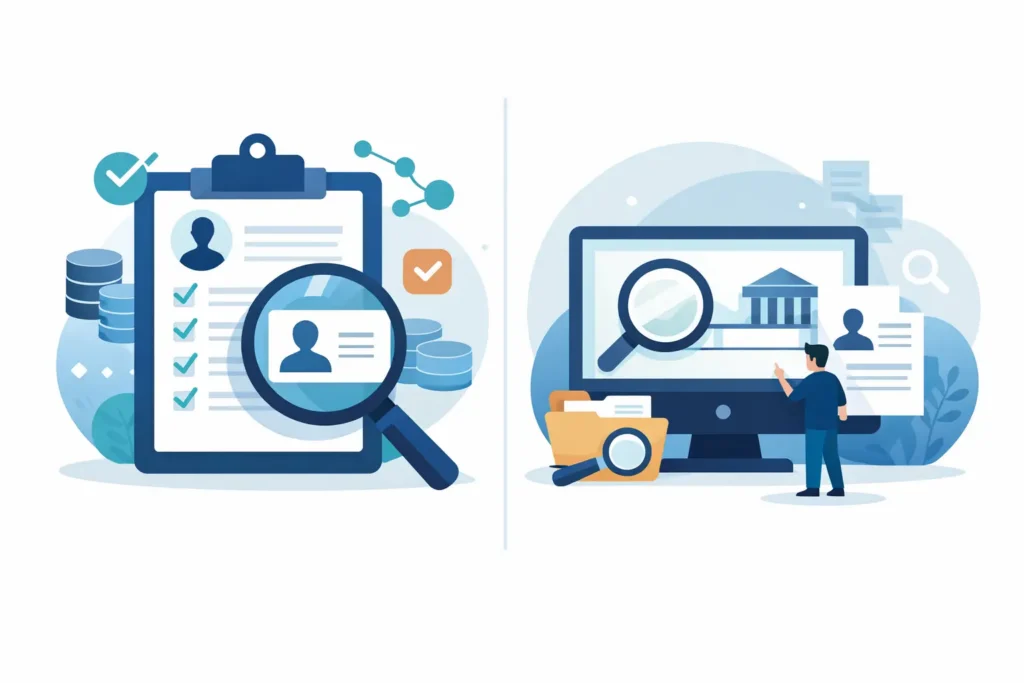
A vendor record can look complete and still create a filing problem. The business name may be familiar, the EIN may have nine digits, and the invoice may already be approved. But if the name and taxpayer identification number do not match IRS records, the payer can face a B-Notice, backup withholding obligations, corrected filings, and avoidable rework. That is the operational difference in TIN matching compared to EIN search: one helps identify a business record, while the other helps validate whether the tax information is accepted for reporting.
For teams preparing 1099 filings, onboarding vendors, or cleaning large payee files, treating these processes as interchangeable creates risk. Each has a specific role. The strongest compliance workflow uses both at the right point in the process.
TIN Matching Compared to EIN Search: The Core Difference
An EIN search is an information-gathering process. It helps a user locate or confirm a business identity using details such as a legal name, DBA, address, industry, or known EIN. This is useful when a vendor record is incomplete, a name appears inconsistent across systems, or a team needs to determine whether it is working with the correct organization.
TIN matching is a tax validation process. It compares a payee name and taxpayer identification number against IRS records to determine whether the combination matches. For business payees, the TIN is often an EIN. For individual contractors and certain other payees, it may be a Social Security number or Individual Taxpayer Identification Number.
The distinction matters because an EIN search can return a plausible result without establishing that the exact payee name-TIN combination will pass IRS validation. A search result is valuable intelligence. It is not a substitute for an authorized TIN match when filing accuracy is the objective.
What an EIN Search Can Solve
EIN search is most useful before validation, especially when your internal vendor data is incomplete or conflicting. A payable team may receive an invoice from a trade name while the W-9 identifies a different legal entity. An onboarding specialist may have a company name but no tax ID. A compliance analyst may need to investigate whether a new vendor appears to be a legitimate operating business.
In these situations, search helps teams resolve identity questions quickly. It can surface legal business names, associated entities, address data, business details, and potential EIN information from available business records. That reduces manual research and gives staff a more reliable starting point for vendor outreach.
Search also supports fraud and risk review. A mismatch between the name on an invoice, the entity named on a W-9, and the organization found in business records deserves attention. It does not automatically prove fraud. Businesses use DBAs, change names, reorganize, and operate through affiliated entities. Still, those differences should be explained and documented before payment or tax reporting proceeds.
What search cannot do is certify that the information is current, taxpayer-authorized, or accepted by IRS matching logic for a specific filing relationship. Teams should avoid filling in a vendor’s tax ID based only on a search result when the required W-9 has not been collected.
What IRS TIN Matching Can Solve
IRS TIN matching is built for reporting accuracy. The process checks whether the submitted payee name and TIN combination matches IRS records. A match gives the payer a stronger basis to report the payee information on information returns. A mismatch identifies a record that needs correction before filing.
This is particularly important for 1099 workflows. A name-TIN mismatch can lead to a B-Notice after filing, forcing the business to contact the payee, solicit corrected information, track responses, and potentially begin backup withholding procedures. By matching records before a return is filed, teams can resolve common defects while there is still time to act.
TIN matching is not the same as a broad business background check, a credit decision, or a guarantee that a vendor is trustworthy. It answers a narrower but critical compliance question: does this payee name correspond to this TIN in IRS records? That narrow answer is exactly what makes it valuable for information reporting operations.
Why a Valid-Looking EIN Is Not Enough
A nine-digit number can be formatted correctly and still be wrong for the payee record. The number may belong to another entity, be paired with an abbreviated name that does not match IRS records, or reflect an old entity after a merger or ownership change. Even simple data-entry errors can turn an otherwise valid record into a filing exception.
Name formatting creates many avoidable mismatches. Legal suffixes, punctuation, spacing, word order, and DBA usage can all affect how a record is handled. An accounts payable system may store “Acme Supply,” while the IRS record uses “Acme Supply Holdings LLC.” If the payee provides the legal name and TIN on a current W-9, that documentation should guide the tax record. The matching result then indicates whether further correction is needed.
There is also a practical limitation: not every vendor relationship has the same tax reporting requirements. Entity classification, payment type, reportable thresholds, and exemptions affect whether a 1099 is required. TIN matching improves data accuracy, but it does not replace the professional determination of whether a payment is reportable.
A Better Workflow: Search First When Needed, Match Before Filing
The right sequence depends on the quality of the records you receive. For a new vendor with a complete, signed W-9, move directly to name-TIN validation. There is no need to search for data you already have from the payee.
For a legacy vendor file with missing fields, conflicting names, or unclear business identities, use search as an investigation tool. Confirm which entity you are dealing with, identify records that need outreach, and flag inconsistencies for review. Then obtain or refresh the W-9 rather than relying on inferred information.
Once the payee has supplied the name and TIN, run TIN matching before the filing deadline. A matched result can move forward in the workflow. A mismatch should enter a documented exception process that includes outreach, W-9 correction, record updates, and revalidation. This turns tax ID verification from a year-end scramble into a controlled operating process.
For high-volume teams, batch processing is the difference between a workable control and a manual burden. Accounting firms, payroll providers, marketplaces, and enterprise AP departments may manage thousands of payee records across multiple clients or business units. Batch search and matching allow teams to prioritize exceptions instead of spending hours reviewing records that are already consistent.
How to Handle Mismatches Without Creating New Risk
A mismatch is a signal to investigate, not permission to guess. Do not alter a vendor’s TIN solely because a search result suggests a different number. Do not assume the invoice name is the legal taxpayer name. Request a corrected or updated Form W-9 from the payee, then update the record based on that documentation.
Your team should also retain a clear audit trail. Record when the W-9 was received, which name and TIN were submitted for validation, the matching outcome, outreach dates, and final corrections. This documentation helps support a reasonable, consistent compliance process if questions arise later.
Exception ownership matters as well. If no one owns failed records, they tend to sit untouched until filing season. Assign mismatches to the appropriate AP, tax, vendor management, or client-service owner. Set a deadline for follow-up and escalate unresolved records before returns are produced.
Choosing the Right Tool for the Job
Use an EIN search when you need to find, investigate, or reconcile business identity data. Use TIN matching when you need to verify the name-TIN combination used for tax reporting. Use both when incomplete vendor data must be researched and then validated before filing.
A unified platform reduces the handoffs that often cause errors: searching one database, tracking W-9s in email, matching records in a separate system, and managing exceptions in a spreadsheet. EINSearch.io supports this operational model with business record search, IRS TIN matching, batch workflows, and API access for teams that need verification built into existing systems.
The practical goal is not to collect more data than necessary. It is to maintain the right data, validate it at the right time, and resolve exceptions before they become notices, penalties, or delayed vendor payments. Build that control into onboarding and regular vendor maintenance, and 1099 season becomes a verification checkpoint rather than an emergency.