

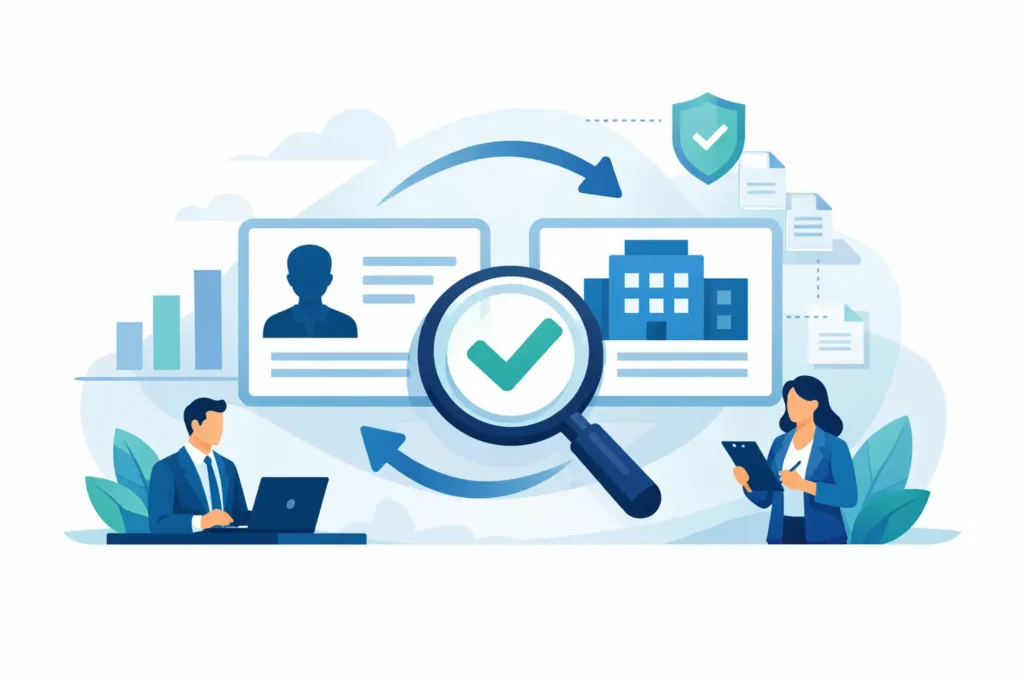
A vendor sends an invoice, a contractor completes a project, or a new payee is added to your system. The tax ID may look valid, but that does not mean it belongs to the legal business name on file. What is EIN matching? It is the process of checking whether an Employer Identification Number (EIN) corresponds to the business name associated with it before that information reaches a 1099, payment workflow, onboarding record, or tax filing.
For accounting, payroll, tax, and compliance teams, this is not a clerical detail. A mismatch can lead to rejected records, IRS B-Notices, backup withholding issues, delayed vendor payments, fraud exposure, and time-consuming remediation after filing season has already started.
What Is EIN Matching?
EIN matching compares two core pieces of business identity information: a company’s legal name and its EIN. The objective is to determine whether the taxpayer identification information provided by a vendor, contractor, or business partner is accurate enough for the intended compliance workflow.
An EIN is a nine-digit federal tax identification number issued by the IRS to many businesses, estates, trusts, and other entities. It is often requested on Form W-9 and used when preparing information returns such as Forms 1099-NEC and 1099-MISC. But an EIN by itself is not sufficient evidence that a payee record is correct. The number must be associated with the correct legal taxpayer name.
In practice, EIN matching may involve an initial business-data lookup, a review of the entity’s legal name and status, and an IRS TIN match when the organization is eligible to use that service. The right level of validation depends on the risk of the transaction and the purpose of the record.
EIN Matching vs. EIN Lookup vs. IRS TIN Matching
These terms are often used interchangeably, but they describe different steps in a strong vendor-validation process.
An EIN lookup helps locate or research business identity details. It can be useful when a vendor record is incomplete, when a team needs to identify the likely legal entity behind a trade name, or when records need to be cleaned before outreach. A lookup can also surface inconsistencies that deserve follow-up, such as a name that does not align with the organization’s address, industry, or known business activity.
EIN matching is the broader reconciliation process. It asks whether the EIN and name belong together and whether the information is suitable for your records. This may include normalizing business names, identifying DBA versus legal-name differences, reviewing entity changes, and resolving formatting errors.
IRS TIN matching is the compliance-focused confirmation step available to authorized payers and their authorized agents. It compares a payee name and TIN combination against IRS records. For organizations filing information returns, this is the most direct way to identify certain name-TIN mismatches before filing.
Public and proprietary business data can help teams investigate and resolve records quickly. It should not be mistaken for an IRS confirmation. If your goal is to reduce 1099 filing risk, use reliable business intelligence for research and direct IRS matching for eligible filing workflows.
Why Name and EIN Mismatches Happen
Most mismatches are not intentional. They often arise because the name on an invoice is a brand name while the W-9 should list the legal entity. A contractor may provide a personal name but use an EIN issued to an LLC. An accounts payable system may retain a prior entity name after a merger, conversion, or ownership change.
Common sources of mismatch include:
- Trade names or DBAs entered instead of legal taxpayer names
- Misspellings, punctuation differences, and incomplete legal suffixes
- A vendor submitting an outdated W-9 after an entity change
- Transposed or incorrectly keyed EIN digits
- Duplicate vendor profiles created across business units
- Fraudulent payment-change requests using a real business name with unrelated tax information
Not every variation indicates a bad record. For example, punctuation and abbreviations may not affect every matching workflow, while a legal-name change after a merger may require a completely new review. The risk lies in assuming that a plausible-looking record is a verified record.
Why EIN Matching Matters Before 1099 Filing
Information returns depend on accurate payee data. When the IRS cannot match the name and TIN reported on a return, the payer may receive a B-Notice. That notice creates a correction workflow: contact the payee, request updated documentation, evaluate backup withholding requirements, update internal systems, and potentially submit corrected returns.
Those tasks consume more than administrative time. They can interrupt vendor relationships, expose weak onboarding controls, and pull tax teams away from higher-value work during the busiest part of the year. For firms processing hundreds or thousands of payees, even a modest mismatch rate becomes a material operational problem.
Pre-filing EIN matching shifts that work to the point where it is easiest to fix. If the record fails validation during onboarding or before payment setup, your team can request a corrected W-9 while the vendor contact, contract, and supporting documentation are readily available. That is faster and more defensible than trying to reconstruct the record months later.
Where EIN Matching Fits in Your Workflow
The strongest approach is not to treat matching as a once-a-year cleanup project. It belongs at several control points in the vendor and contractor lifecycle.
At onboarding
Collect a completed Form W-9 and compare the submitted legal name and EIN with available business records. If the name is a DBA, identify the underlying legal taxpayer name before the record is approved. Establish clear ownership for exceptions so incomplete records do not move forward by default.
Before payment changes
Payment change requests are a common fraud target. EIN matching does not replace bank-account verification or callback controls, but it gives compliance teams another identity signal. A name-EIN mismatch, unexplained entity change, or new tax profile should trigger additional review before funds are redirected.
Before 1099 preparation
Run a batch review of all reportable vendors well before filing deadlines. Prioritize records with missing W-9s, recently changed names, invalid formatting, duplicate profiles, or historical mismatch results. Then use IRS TIN matching where authorized to confirm the name-TIN combinations that will be reported.
During ongoing master-data maintenance
Vendor records change. Businesses dissolve, reorganize, change names, and update tax classifications. Periodic validation keeps old records from quietly becoming filing errors. This is especially valuable for enterprise teams whose vendor data is spread across ERP, procurement, payroll, and payment systems.
A Practical EIN Matching Process
Start by standardizing the data you already have. Separate legal name, DBA, EIN, address, contact name, and entity type into distinct fields. A record that combines a brand name and legal name in one field is harder to validate and harder to defend in an audit.
Next, screen for obvious issues: missing EINs, invalid nine-digit formats, duplicate EINs tied to unrelated names, and names that do not match the supporting W-9. Business-data search tools can help enrich incomplete records and identify likely legal entities, but unresolved conflicts should go back to the vendor for clarification.
Then apply the appropriate confirmation method. For reportable payees, submit eligible name-TIN combinations through an authorized IRS TIN matching workflow. For non-filing identity research, document the source of the business information and the action taken to resolve discrepancies.
Finally, retain an audit trail. Record when the match was performed, the source used, the result, the reviewer, and any vendor documentation received. Compliance teams need more than a clean vendor list. They need evidence that exceptions were identified and handled consistently.
Batch Matching and API Validation at Scale
Manual review may work for a small practice with a limited vendor roster. It does not scale for payroll providers, financial institutions, marketplaces, or enterprise accounts payable teams handling thousands of records across multiple systems.
Batch matching allows teams to upload and evaluate large vendor files before a filing deadline. It is useful for annual 1099 preparation, acquisition-related data cleanup, vendor master consolidation, and recurring quality-control reviews. The key benefit is prioritization: teams can focus their outreach on records that actually need correction instead of requesting new W-9s from every vendor.
API-based validation supports a more proactive model. Rather than waiting for year-end, organizations can check tax identity data as vendor records are created or changed. That reduces duplicate entry, limits downstream rework, and applies the same validation standard across departments.
EINSearch.io supports this type of workflow with instant business searches, IRS TIN matching capabilities, batch processing, and real-time API access designed for compliance operations. The right configuration depends on your volume, system architecture, and whether your organization needs research data, direct IRS validation, or both.
What EIN Matching Cannot Do
EIN matching is a critical control, but it is not a complete fraud or vendor-risk program. A valid name-EIN combination does not confirm that an invoice is legitimate, that a bank account belongs to the payee, or that a vendor is authorized to perform a particular service. It also does not replace sanctions screening, beneficial ownership review, bank verification, or internal approval controls where those measures are required.
It does, however, close a common and preventable gap: relying on unverified taxpayer information in high-consequence financial and reporting workflows. When a record cannot be matched, treat it as an exception to resolve, not a detail to ignore. That discipline protects filing accuracy long before a B-Notice turns a small data problem into a costly operational event.