

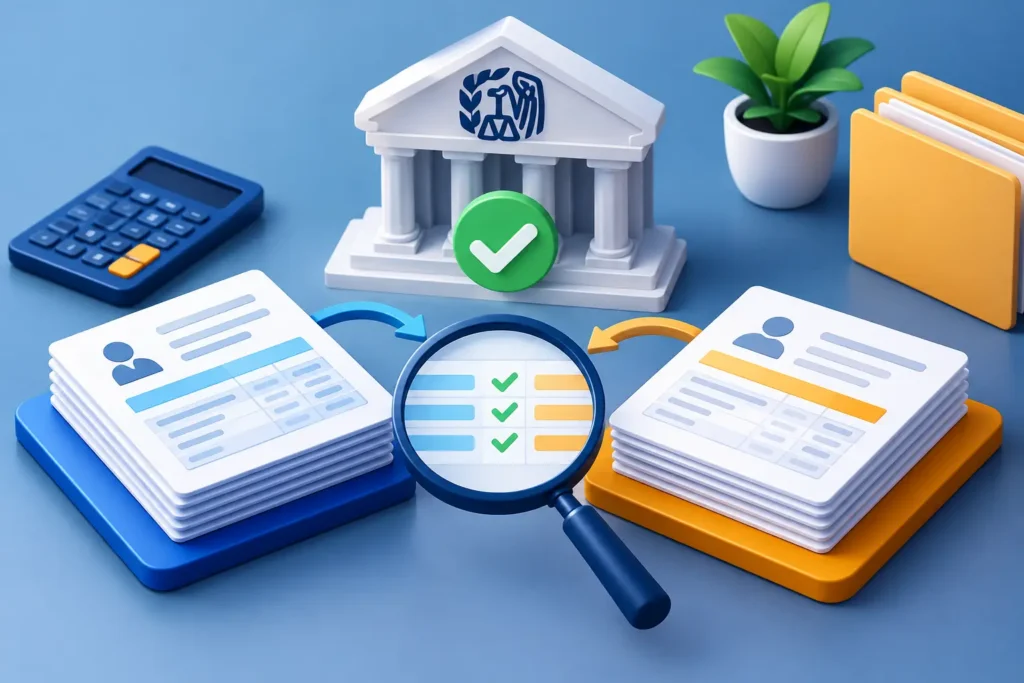
A vendor can look legitimate, submit a completed W-9, and still create a reporting problem months later. A single transposed digit, outdated legal name, or incorrect entity classification can cause a mismatch when a 1099 is filed. IRS matching procedures give accounts payable, tax, and onboarding teams a disciplined way to identify those issues before payments and filings turn into B-Notices, backup withholding work, or avoidable corrections.
For organizations paying contractors, suppliers, landlords, attorneys, and other reportable vendors, TIN matching is not administrative housekeeping. It is a control point. Done early and consistently, it protects 1099 accuracy, improves vendor master data, and gives compliance teams a documented process for handling exceptions.
What IRS Matching Procedures Actually Verify
IRS matching procedures compare the taxpayer identification number provided by a payee with the name associated with that number in IRS records. For most business vendors, the TIN is an Employer Identification Number, or EIN. For sole proprietors and individual contractors, it may be a Social Security number or Individual Taxpayer Identification Number.
The core question is straightforward: does the TIN and name combination match? But the operational reality requires more care. The submitted name must be the legal name tied to the TIN, not necessarily the vendor’s trade name, division name, storefront name, or a shortened version used on invoices.
A successful match supports the data used for information reporting. A non-match does not automatically prove fraud or mean the vendor should be rejected. It can result from a recent legal-name change, an incorrectly completed W-9, a missing middle initial for an individual, or use of a DBA rather than the entity’s legal name. The right response is a controlled follow-up process, not an assumption.
Why Timing Determines Whether Matching Works
Many teams wait until January to validate vendor records for the prior year’s 1099 filing. That approach creates a predictable bottleneck: hundreds or thousands of records require correction when vendors are slow to respond, staff are handling year-end close, and filing deadlines are approaching.
The more effective procedure is to match during vendor onboarding, before the first payment is approved. If a match fails, the vendor record can be held for review while the relationship is still new and the request for a corrected W-9 is routine. Matching should also occur when a vendor changes its legal name, updates banking information, changes entity type, or is added to a payment workflow after an acquisition.
For high-volume operations, periodic rematching is also practical. A vendor master file can remain active for years, while taxpayer data changes due to mergers, conversions, name changes, or business closures. Annual or pre-filing batch validation catches stale records before the 1099 process begins.
A Practical IRS Matching Procedure for AP Teams
A reliable process starts with clean source data. Require a signed or electronically certified W-9 before setup, and capture the legal name, TIN, federal tax classification, address, and any DBA separately. Do not use the DBA as the default matching name unless it is also the legal name associated with the TIN.
Next, standardize the data before submitting it for validation. Remove avoidable formatting inconsistencies, confirm whether the payee is an individual or entity, and make sure the name field contains the information required by the matching workflow. This sounds basic, but poor data hygiene is one of the most common causes of false exceptions.
Then run the match and record the result in the vendor master or compliance system. The result should be associated with the date, the exact name and TIN combination submitted, the source document, and the employee or system process responsible for the check. This record matters when an internal auditor, tax director, or regulator asks how the organization validated payee information.
When a result does not match, route it to an exception queue. The payee should be asked to confirm its legal name and TIN and provide an updated W-9 if necessary. Payment teams should not silently edit tax data based on an invoice header, email signature, or online business listing. The vendor must certify the corrected information.
Finally, establish a decision rule for unresolved exceptions. Depending on the payment type, payee status, and internal risk policy, that may mean delaying setup, limiting payment release, escalating to tax compliance, or documenting why business operations require payment before the exception is resolved. The appropriate action depends on the facts, but the exception should never disappear into an unmonitored spreadsheet.
Name Control Issues Need Special Attention
The name control problem is where many otherwise careful teams lose time. A business may market itself under one name but file taxes under another. A single-member LLC may provide an EIN but require the owner’s name in a specific field depending on how it is taxed. An individual contractor may use a professional name that does not match the name associated with their TIN.
Do not ask AP staff to guess. Build clear instructions into the W-9 collection process, maintain separate legal-name and DBA fields, and provide an escalation path for unusual entity structures. A fast match is valuable, but a fast match against poorly captured data simply produces faster rework.
IRS TIN Matching Procedures at Scale
Manual validation is manageable for a small vendor file. It becomes risky when an organization is adding hundreds of vendors per month, processing contractor payouts, or preparing thousands of 1099 records. At that point, the process must operate through batch files or an API connected to onboarding, ERP, procurement, payments, or tax reporting systems.
A high-volume workflow should distinguish between immediate screening and formal follow-up. Real-time validation can prevent a bad record from entering the vendor master. Batch matching can clean legacy data and prepare large files for filing. Both are useful, but they solve different operational problems.
Speed is especially important for merchant underwriting, financial services onboarding, and account approval workflows. A delayed response can mean an abandoned application or a manual-review queue that costs more than the risk it was intended to reduce. EINSearch.io combines a 25 million EIN database and a 700 million tax ID data index with IRS TIN matching capabilities, helping teams screen records rapidly while maintaining a path to validation and exception handling.
Database intelligence and IRS confirmation should be treated as complementary controls. A large business identity database can identify likely formatting issues, legal-name relationships, and potential fraud signals quickly, including when an external matching workflow is unavailable. Formal IRS matching remains the appropriate control when the business needs confirmation for reporting accuracy and documented tax compliance.
How Matching Reduces B-Notices and Backup Withholding Risk
A B-Notice typically arrives after information returns have been filed with a name and TIN combination that does not match IRS records. By then, the organization must contact the payee, track required documentation, and potentially apply backup withholding if the issue is not resolved under the applicable rules.
Preventing that sequence is less expensive than managing it. Pre-payment or pre-filing matching reduces the chance that incorrect data reaches the return. It also gives the organization time to address errors professionally, rather than sending urgent notices after a filing failure.
Still, matching is not a guarantee against every reporting issue. A valid name and TIN combination does not determine whether a payment is reportable, which form applies, whether an exemption applies, or whether backup withholding is required in a specific situation. Taxability and reporting classification need their own controls. Matching verifies identity data, not the full tax treatment of a transaction.
Controls That Make the Process Defensible
The strongest matching programs are consistent, not merely fast. They define who can create or change vendor tax records, require evidence for changes, restrict access to full TINs, and keep an audit trail of validations and exceptions. Teams should also set revalidation rules for inactive vendors returning to service and for material profile changes.
Security deserves equal attention. TINs are sensitive data. Limit access to staff with a business need, avoid sending full numbers through ordinary email, apply retention policies, and ensure third-party tools meet the organization’s security and privacy requirements. Compliance controls that expose taxpayer data create a different kind of risk.
A useful measure of success is not simply the number of records matched. Track exception rates, time to resolve mismatches, percentage of vendors verified before first payment, B-Notice volume, and corrections required after filing. Those metrics show whether the procedure is preventing risk where it matters: at the point of vendor creation and payment approval.
The best time to fix a name and TIN mismatch is when the vendor is asking to be paid, not when your team is responding to an IRS notice. Make matching a standard onboarding control, give exceptions an owner, and preserve the evidence. That is how a routine validation step becomes a practical defense against filing errors, fraud, and costly rework.